
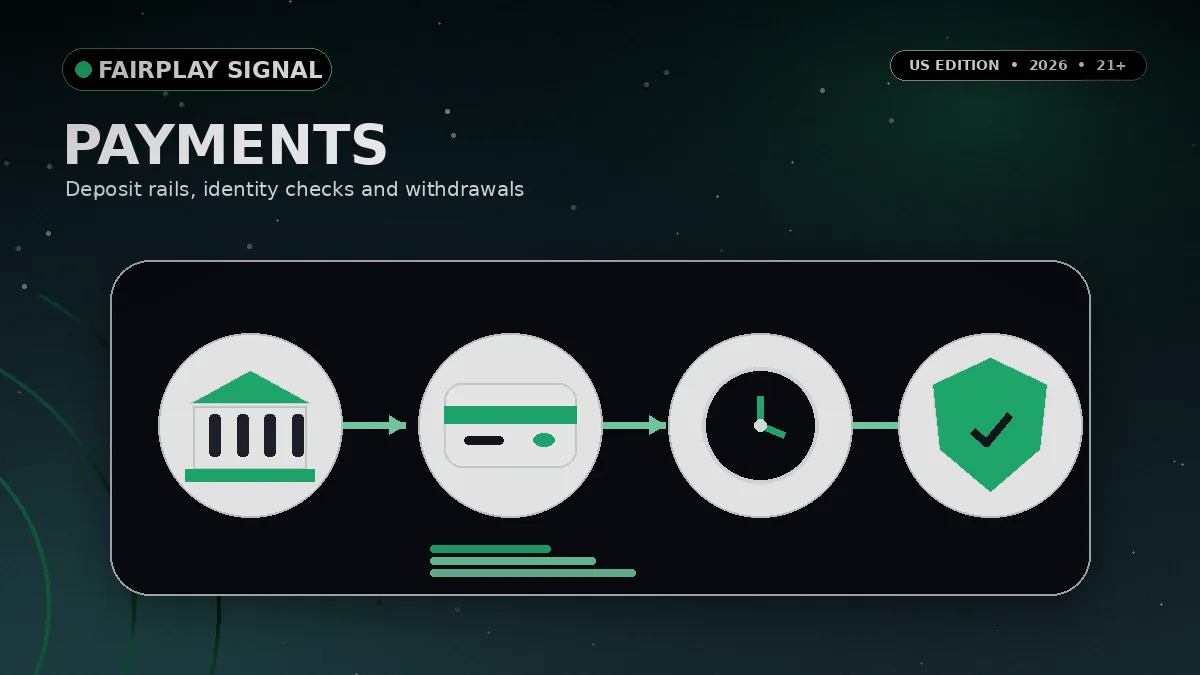
Every US casino cashier makes the same promise: fast, easy payouts. Almost none of them define what "fast" means in hours or business days, which is exactly the gap a no deposit bonus claim likes to hide in. FairPlay Signal exists to close that gap with published numbers instead of adjectives, so you can judge a cashier before you ever load a dollar into it.
This page walks through every common deposit and withdrawal method available to US players, the identity checks that slow your very first request, how a no-deposit cashout actually pays out, and what taxes look like once a win clears. Treat it as a reference to check any casino's cashier claims against, method by method.
A quick scope note before we start. Everything here describes state-licensed real money casinos, the only US sites where a withdrawal is paid under enforceable rules. Social and sweepstakes platforms use a different, virtual-currency model with its own redemption process, so their timelines and limits do not map cleanly onto the regulated cashier we describe below.
How Deposits, Withdrawals and No Deposit Bonus Payouts Work
A licensed US casino cashier runs two separate systems that share one screen. Deposits move money into your account and post almost instantly, since the casino is receiving funds and has little reason to delay. Withdrawals move money back out, and that direction gets reviewed before it's released.
A no deposit bonus payout adds a third layer on top of standard withdrawal review: wagering must clear first, and a maximum cashout usually limits the total before the normal payout process even begins. Understanding all three layers is the difference between a realistic expectation and a frustrating surprise at the cashier.
Deposits, Withdrawals and the Cashier Flow
Most cashiers group methods into one shared list for deposits and a shorter list for withdrawals, since not every deposit option can send money back. Debit cards, for example, are common for funding an account but rarely support a payout at all in the US market.
Knowing which methods work both ways before you deposit saves a step later. If a fast withdrawal matters to you, pick a deposit method that also appears on the casino's withdrawal list, such as an e-wallet or a Play+ prepaid card, so your money can return the same way it went in.
Pending Periods and Reversal Windows
Once you request a withdrawal, many casinos apply a pending period before the payout is finalized. During that window, often several hours to a day, the request sits in review and can sometimes be reversed back into your balance. Some players use that reversal feature deliberately; others get caught by it and gamble away money they meant to cash out.
The pending period is separate from the method's own transfer time, and it stacks on top. A casino that "processes in 24 hours" and then hands off to an e-wallet may still be two days from your bank. Reading the cashier's stated pending window alongside the transfer estimate gives you the true end-to-end timeline.
Deposit Methods for US Players in 2026
Funding an account at a state-licensed casino is usually the easy half of the process. Most cashiers accept a mix of debit cards, online banking transfers, e-wallets and casino-branded prepaid cards, with instant posting on nearly all of them.
The method you choose for a deposit doesn't have to match the one you'll use later to withdraw, but picking a method that supports both cuts out a step. Our real money casinos guide covers which operators among the best online casinos usa players can legally reach support the widest banking menus.
PayPal and Other E-Wallets
Where available, PayPal is one of the more reliable options at regulated casinos because it settles quickly in both directions and doesn't route through a card network. Other e-wallets appear less consistently across states, so check the cashier list before assuming one is offered.
E-wallet withdrawals typically post within a few hours to one business day once your identity is verified, making them the closest thing to a genuine fast payout among common US casino methods. The catch is that you generally have to deposit with the same wallet first before you can withdraw to it, so set it up early.
Play+ Prepaid Cards and Online Banking
A Play+ card is a prepaid account branded to a single casino; it loads from a bank account or debit card and can also receive withdrawals, often faster than a standard transfer. Online banking, sometimes called an e-check or instant ACH, links your bank account directly to the cashier.
Online banking deposits are typically instant, but the return trip for a withdrawal takes longer, usually one to three business days, because it routes through the standard ACH network rather than a prepaid ledger. For many players the Play+ card lands in a useful middle ground: quicker than ACH, and accepted more widely than PayPal across states.
Debit and Credit Cards
Debit cards are the default deposit method at most licensed US casinos and usually post instantly. Credit card deposits are a different story: many issuers decline gambling transactions outright or code them as a cash advance with extra fees, so a declined card is often the bank's decision rather than the casino's. This is one downstream effect of how payment processing is treated under federal law, discussed in our licensing and regulation guide.
Even when a card deposit succeeds, most US cashiers cannot send a withdrawal back to a credit card, and debit card payouts are only available at some operators. If you deposit by card, plan to withdraw through an e-wallet, Play+ or online banking instead, and expect to complete verification before that first payout is released.
Withdrawal Methods and Typical Payout Speed
Withdrawal speed is where cashier marketing and cashier reality tend to separate. A casino can advertise "instant payouts" while only one of six listed methods actually qualifies, and even that one depends on your verification status.
The table below reflects realistic ranges reported across regulated US operators rather than best-case marketing numbers. Treat any casino's own published timeframe as more reliable than a generic claim on its homepage, and read it alongside the pending window described earlier.
Debit Card, ACH and Cash-at-Cage Payouts
Debit card withdrawals, where offered, typically return to the same card in one to three business days. Standard ACH bank transfers run similarly. Cash at the casino cage, available where an online operator has a retail partner property, is same-day but requires an in-person visit and ID.
Paper checks remain the slowest common option, often seven to ten business days including mail time, and are usually a fallback rather than a first choice for players who value speed. The ranges in the table assume your account is already verified; an unverified first request adds the KYC time on top.
| Payment method | Typical use | Typical payout speed |
|---|---|---|
| PayPal / e-wallet | Deposits & withdrawals | Same day–24 hours after verification |
| Play+ prepaid card | Deposits & withdrawals | 24–48 hours |
| Online banking / ACH | Deposits & withdrawals | 1–3 business days |
| Debit card | Mostly deposits, some withdrawals | 1–3 business days if supported |
| Cash at the casino cage | Withdrawals at a retail partner | Same day, in person |
| Paper check by mail | Withdrawals | 7–10 business days |
Cash at the Cage and Crypto Where State Rules Permit
Two options sit outside the standard debit-and-e-wallet menu and cause the most confusion for US players: collecting a payout in cash at a physical property, and using cryptocurrency. Both exist, but both come with sharp limits that the marketing rarely spells out.
We treat these the same way we treat every method here, by describing what actually happens at licensed operators rather than what an offshore ad promises. Where a method is not genuinely available at a state-regulated casino, we say so plainly instead of implying it is a shortcut.
Cash at a Retail Partner Cage
Because online casinos in regulated states are usually tied to a land-based partner, some let you withdraw in cash at that property's cashier cage. It is often the single fastest way to hold your winnings, since there is no transfer time at all, and it can be handy for a larger sum you would rather not wait on.
The trade-off is obvious: you have to be physically at the property, bring valid ID, and the option only exists in states where the operator runs a retail cage. For most players it is a situational tool rather than an everyday method, but it is a legitimate and genuinely quick one where offered.
Crypto at US Casinos: A Careful Note
Cryptocurrency is heavily marketed as an instant-payout solution, but at state-licensed US real money casinos it is uncommon; regulated cashiers still lean on banks, cards and approved processors. Most sites advertising crypto deposits and withdrawals to US players are unlicensed offshore operators that sit outside US consumer protection entirely.
Where a licensed operator does support a crypto rail, it will be listed in the state-approved cashier and still requires full identity verification, so it is not a way around KYC or the 21+ rule. If a site presents crypto as an anonymous, verification- free shortcut to a fast payout, treat that as a warning sign, not a feature, and confirm licensing before depositing.
No Deposit Bonus Cashouts: How the Math Works
A no-deposit offer pays out through the same withdrawal system as real money play, but with two extra conditions layered in front: a wagering requirement that must be cleared first, and a maximum cashout that caps what actually leaves your account.
Neither condition is unusual or improper on its own. The problem shows up when players clear the wagering, see a large balance, and are surprised to learn most of it is trimmed before the withdrawal is even requested. This is why we frame a real money no deposit bonus as a low-stakes trial, not a payday.
The Maximum Cashout Cap, Explained
Say a casino credits $30 in free-play funds at a 40x wagering requirement, meaning about $1,200 in total bets before anything can be withdrawn. If that same promotion carries a $75 maximum cashout, any winnings above $75 are removed once wagering clears, regardless of how the session actually went.
This cap is disclosed in the promotion's terms, not hidden, but it's easy to skip past. Our casino bonus USA breakdown walks through the wagering side of the math in more depth for every common offer type, and shows how a licensed no deposit bonus compares with a matched deposit offer.
A Worked No Deposit Bonus Cashout Example
Walk one all the way through. You claim a no deposit bonus usa offer of 25 free spins at $0.20 each, worth $5, with winnings converted to bonus credit at a 35x wagering requirement and a $100 maximum cashout. The spins return $18 in bonus funds, so you now owe roughly $630 in total wagering before any cashout.
Say slots cooperate and you clear it with $240 on the balance. The $100 cap trims that to $100, and only then does the normal withdrawal flow begin: verification if you have not done it, a pending window, then the transfer time for your chosen method. The realistic outcome is a real but modest payout, on a normal cashier timeline, not an instant windfall.
Why Your First Withdrawal Takes the Longest
Nearly every delayed first payout traces back to the same cause: identity verification, often called KYC, or "know your customer." Regulated states require it before a casino can release any funds, no matter how fast the chosen method normally is.
This is a one-time hurdle in most cases. Once your documents are reviewed and approved, later withdrawals through the same method typically process at the method's normal speed, without repeating the full check. The single best move a player can make is to complete verification right after signing up, not at the moment of the first cashout.
What KYC Verification Actually Checks
A standard review confirms three things: that you are who you say you are, usually via a government-issued photo ID; that you meet the 21+ age requirement; and that you're physically located in a state where the casino holds an active state gaming license.
Some casinos also match your payment method to your identity, which can mean a photo of the card used to deposit. Submitting clear, current documents on the first attempt is the single biggest thing a player can do to speed this step up, since a blurry ID or a mismatched address restarts the clock.
What Makes a Genuine Fastest Payout Casino USA in 2026
A real fastest payout casino usa candidate publishes exact numbers on its own site: hours for e-wallets, business days for bank methods, and any conditions that extend those windows, such as pending verification or a large-withdrawal review.
A candidate that only says "fast" or "instant" without a number attached is making a marketing claim, not a commitment. The difference matters most the first time you actually try to cash out, which is precisely when an underdefined promise tends to fall apart.
Reading a Casino's Published Payout Policy
Look for a dedicated banking or payout page in the cashier or footer, not just a line in the promotions section. A trustworthy policy names each method, states a processing window in hours or days, and discloses any withdrawal limits per transaction or per day.
If that page doesn't exist, or support gives a different answer than the website, treat any "fast payout" claim as unverified until you've tested a small withdrawal yourself. A quick low-value cashout is the cheapest due diligence you can run on a new operator.
Signs a Fast-Payout Claim Is Real
- Specific hours or business-day windows are published
- Verification requirements are explained up front
- Per-method limits and any installment rules are disclosed
- Support can confirm the same numbers the website states
Signs It's Just Marketing
- Only vague words like "instant" or "fast" appear
- No mention of identity verification timing at all
- Withdrawal limits are unclear or missing entirely
- Support gives a different timeframe than the site does
Matching a Payout Method to How You Play
The "fastest" method is not the same for everyone. A casual player cashing out $60 after a session on us online slots has different priorities than someone withdrawing four figures after a strong month. Speed, per-transaction limits and how you like to hold money all weigh in.
For small, frequent cashouts, an e-wallet or Play+ card usually wins on speed and convenience. For a large sum, reliability and clear large-withdrawal rules matter more than shaving a few hours, and a bank transfer or cage payout is often the steadier choice. The top rated us casinos make both paths clear rather than forcing everyone down one lane.
Withdrawal Limits and Installment Payouts
Many casinos cap how much you can withdraw per transaction, per day, or per week, and a big win can exceed those caps. When that happens, the operator pays you in installments over several cycles rather than in one lump sum, which stretches the real timeline well beyond the method's headline speed.
These limits are disclosed in the same payout policy that lists processing times, so read both together. If you expect to play at higher stakes, confirm the per-day and per-week ceilings before you deposit, so an installment schedule is a known plan rather than an unwelcome surprise at the cashier.
Taxes on Casino Winnings and Form W-2G
Gambling winnings, including from a no-deposit offer, are generally treated as taxable income by the IRS, and many states tax them too. This applies regardless of whether the money was won from your own deposit or from free-play credit.
This section is general information only, not tax advice. Rules vary by state and by individual circumstances, so keep your own records and confirm specifics with a qualified tax professional, especially after a larger win. How you were paid out has no bearing on whether a win is reportable.
When a W-2G Gets Issued
Casinos issue a Form W-2G once winnings from certain games cross a reporting threshold that varies by game type, sending a copy to both the player and the IRS. Getting one doesn't change the payout process itself, and not receiving one does not mean a win is untaxed.
Keep a simple log of sessions, dates, wins and losses. It won't affect how quickly a withdrawal clears, but it makes tax time considerably easier if a W-2G, or several, show up in a given year, and it supports any loss deductions you may be entitled to claim.
Responsible Gambling and Payout Safety (21+)
Payout speed only matters within a session you can afford, which is why player protection sits next to banking on every page here. Treat any casino play, deposit-funded or no-deposit, as entertainment with a spending limit set in advance.
If waiting on a withdrawal, or chasing one, starts to feel more stressful than the play itself, that's a signal worth taking seriously rather than pushing through. The reversal window on a pending payout is a common trap here: money you decided to cash out is money you decided to keep.
21+ only. If gambling is causing financial strain or stress, free and confidential help is available 24/7 from the National Council on Problem Gambling — call or text 1-800-GAMBLER. Regulated states also run their own self-exclusion programs, and every licensed casino offers voluntary self-exclusion and deposit-limit tools.
Self-Exclusion and Deposit Limits
Every regulated state runs a self-exclusion program through its gaming regulator, blocking licensed casinos for a chosen period or permanently. Enrolling is free and enforced against operators licensed in that state, and it applies before any question of payouts arises.
Inside your account, most casinos also let you set a deposit limit, a loss limit, or a temporary cool-off period without a full self-exclusion. Setting these before a session starts is far more effective than trying to stop mid-session, and they work alongside, not instead of, the state program.
Red Flags: No Deposit Bonus Payout Scams and Withdrawal Delays
Most payout problems aren't dramatic; they're a pattern of small stalls that add up. An unlicensed site might approve a small no-deposit win instantly, then quietly slow-walk a larger, later withdrawal with repeated document requests.
A single delay isn't automatically a scam; verification takes real time. But a site that keeps moving the goalposts, requests a new deposit before releasing a payout, or can't name its licensing regulator has crossed from slow into unsafe, and no bonus is worth that exposure.
Common Excuses for a Withheld Payout
Watch for requests to "verify" through a new deposit, sudden new terms not shown at sign-up, or a support team that won't put a specific timeframe in writing. None of these appear at casinos licensed by a real state regulator, and any one of them is reason enough to stop depositing.
If a withdrawal request goes unanswered past the site's own stated window, the regulator listed on the casino's licensing page, not the casino's own support chat, is your next and strongest point of contact. See our review standards for how we vet payout claims before we ever call a cashier reliable.
Sources
- American Gaming Association — US gaming industry research and player-protection resources
- NJ Division of Gaming Enforcement — licensing and payout-rule oversight for a regulated state
- Pennsylvania Gaming Control Board — licensed-operator rules and player complaint routes
- National Council on Problem Gambling — free, confidential help, call or text 1-800-GAMBLER
Read more
- real money casinos USA — licensing, verification and withdrawals
- casino bonus USA math — wagering, caps and no deposit bonus terms
- licensing and regulation — states, UIGEA and the Wire Act
- no deposit bonus hub — the full 2026 player guide

Timothy C. Duran
Responsible Gaming & Policy Editor · FairPlay Signal
Timothy C. Duran covers US state gaming regulation and player protection at FairPlay Signal, with particular attention to payout timing, verification rules and fair bonus terms. They test cashier claims against published policy rather than repeating marketing copy, and believe a clear payout timeframe is worth more to a player than any headline offer.
Last updated 07/20/2026